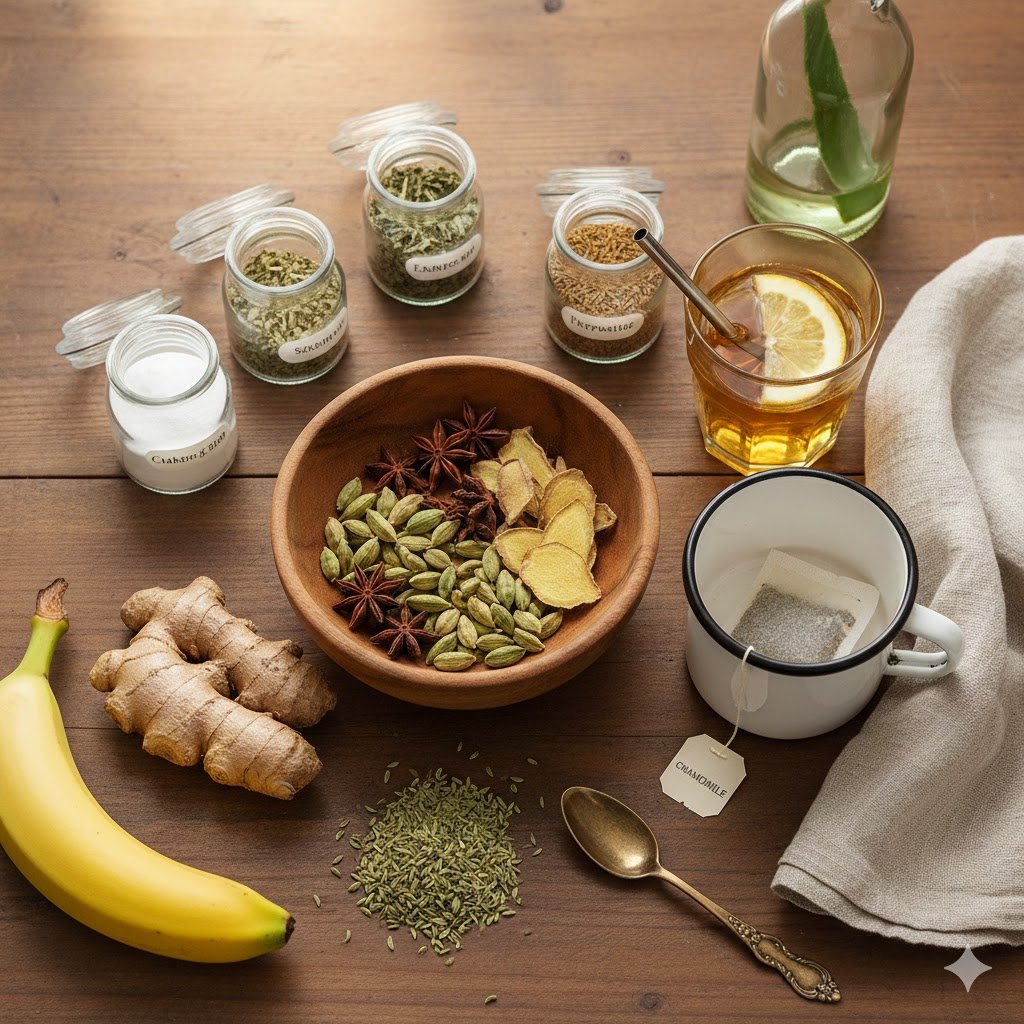
Need natural remedies for indigestion? Discover 9 safe, natural remedies like Ginger Tea and Baking Soda. Get the exact dosage, preparation steps, and critical safety warnings for lasting relief.
I. Introduction: Defining the Problem (Dyspepsia)
When a heavy meal turns into a sharp pain, bloating, or a sour stomach, the need for relief is immediate. Indigestion is one of the most common and uncomfortable digestive complaints, often striking at the most inconvenient times. For a deeper look at how your stomach and brain handle hunger and fullness, see this guide on the stomach and brain hunger connection . While pharmaceutical antacids offer a quick solution, many people prefer to start with natural, kitchen-based remedies for speed, accessibility, and fewer side effects. The key to successful home treatment is not just knowing what to take, but knowing the exact dosage and safety warnings—an essential practice for establishing authority and trust in health advice.
Defining Indigestion (Dyspepsia)
Indigestion, medically known as dyspepsia, is a general term used to describe discomfort or pain in the upper abdomen. It is characterized by symptoms such as:
- Feeling excessively full shortly after starting a meal (early satiety).
- An uncomfortable fullness after eating a meal (postprandial fullness).
- Burning pain or discomfort in the upper belly (heartburn).
- Bloating, nausea, and excessive burping.
Indigestion occurs when excess stomach acid irritates the lining of the digestive tract, when the stomach muscles fail to move food efficiently, or when the digestive system experiences spasms. Emotional stress can also disturb digestion; this article on the gut and mood connection explains how your feelings may worsen indigestion symptoms.
The Blueprint List: Your Quick-Fix Arsenal
Before diving into the detailed methods, here are the top four remedies known for their speed and effectiveness—these are the solutions you should reach for first. Simple daily habits, such as starting your day with water, can also support smoother digestion; see the guide on morning water benefits for more details.
- 1. Baking Soda (Sodium Bicarbonate): For rapid, chemical neutralization of excess acid.
- 2. Ginger Root: For calming nausea and accelerating the movement of food out of the stomach.
- 3. Peppermint Tea: For relaxing painful muscle spasms and relieving gas.
- 4. Fennel Seeds: For quick relief from gas and bloating after a large meal.
II. Instant Relief: The Top 5 Natural Remedies
This section focuses on remedies designed to provide quick, immediate relief from active indigestion symptoms, such as heartburn, nausea, and acute bloating. These work rapidly by neutralizing acid or calming digestive spasms.
1. Baking Soda (Sodium Bicarbonate): The Rapid Antacid
Baking soda, or Sodium Bicarbonate, is perhaps the fastest-acting home remedy for heartburn and sour stomach. It is a highly alkaline compound that chemically reacts with stomach acid (Hydrochloric Acid) to neutralize it instantly, thereby raising the stomach’s pH level.
Actionable Blueprint: Exact Dosage
- **Preparation:** Mix 1/2 teaspoon of baking soda in a full 4–8 ounce glass of cool water.
- **Dosage Limit:** Do not take more than seven $1/2$-teaspoon doses in a 24-hour period.
⚠️ Critical Safety Warnings
- **Sodium Overload:** Consult your doctor before using if you are on a sodium-restricted diet.
- **Drug Interaction:** Do not consume within two hours of taking any other prescription drug.
2. Ginger Root: Nausea Relief & Digestive Accelerator
Ginger is effective thanks to its active compounds, gingerols and shogaols. These compounds act as mild antispasmodics, speeding up gastric emptying and directly reducing bloating and nausea.
Actionable Blueprint: Preparation Options
- **Fresh Ginger Tea:** Steep $\mathbf{1}$ to $\mathbf{2}$ thin slices in hot water for 5–10 minutes.
- **Capsules:** Typically $\mathbf{1,000 \text{ mg}}$ to $\mathbf{2,000 \text{ mg}}$ daily, divided.
⚠️ Critical Safety Warnings
- **Heartburn Risk:** Limit total daily consumption to no more than $\mathbf{4}$ grams of dried ginger.
- **Blood Thinners:** Consult your doctor if you are taking blood-thinning medication.
3. Peppermint and Chamomile Tea: Muscle Relaxants
Peppermint contains menthol, a powerful natural antispasmodic that relaxes the smooth muscles of the digestive tract, calming spasms that cause gas and cramps.
Actionable Blueprint: Tea Preparation
- **Preparation:** Steep 1 tsp of dried leaves in 8 oz of boiled water for 5–10 minutes.
- **Timing:** Drink slowly between meals or 30 minutes after eating.
⚠️ Critical Safety Warning
- **Crucial GERD Note:** Avoid Peppermint Tea if you have chronic GERD, as it can worsen acid reflux.
4. Apple Cider Vinegar (ACV): Balancing Stomach Acid
ACV is used when indigestion is suspected to be caused by insufficient stomach acid. It provides an acidic boost to improve digestive efficiency.
Actionable Blueprint: ACV Dilution
- **Preparation:** Mix $\mathbf{1}$ to $\mathbf{2}$ teaspoons of ACV with a full glass ($\mathbf{8 \text{ oz}}$) of water.
- **Protection:** Always drink with a straw and rinse your mouth with water afterward.
⚠️ Critical Safety Warnings
- **Enamel Erosion:** Never drink ACV undiluted.
- **Avoidance:** Discontinue if pain increases, as it can aggravate high-acid reflux.
5. Fennel and Caraway Seeds: Gas and Bloating Dispelers
These seeds contain volatile oils that act as carminatives, helping the body expel accumulated gas and reducing painful bloating after a meal.
Actionable Blueprint: Simple Consumption
- **Dosage:** Chew $\mathbf{1}$ teaspoon of the seeds slowly and thoroughly immediately after a large meal.
⚠️ Critical Safety Warnings
- **Pregnancy:** Consult a doctor before using medicinal amounts of fennel seed extract during pregnancy.